Eat the Street: A Nervous Newcomer's Tour of Hefei's Night Markets, Stall by Stall
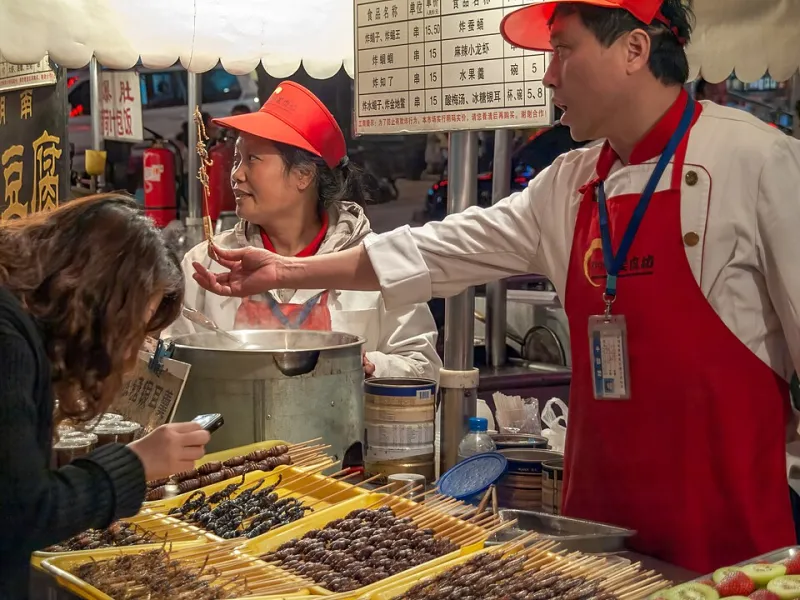
Photo: Ermell, CC BY-SA 4.0, via Wikimedia Commons
Somebody at your new job will eventually say the words "night market" and gesture vaguely in the direction of Wuhu Road, and you'll nod like you know what that means. You don't yet. That's fine. Neither did any of us.
Here's the honest version: Hefei's night markets are loud, smoky, gloriously cheap, and about 90% friendlier than they look from the sidewalk. The other 10% is just learning a few unwritten rules. Consider this your field guide.
First, the Ground Rules
Before we talk food, three things that will save you embarrassment:
Cash and WeChat/Alipay both work, but QR codes rule. Most stalls have a laminated QR code taped to the cart. Set up mobile payments before you go — fumbling for cash while eight people queue behind you is a special kind of stress.
Pointing is a complete language. Seriously. Watch what other people order, point at it, hold up fingers for how many. You will survive entire evenings on this system. A smile goes a long way; vendors deal with confused foreigners constantly and most find it endearing.
Stalls with lines are safe bets. Not just for taste — high turnover means food isn't sitting around. This is the single most useful food-safety heuristic in China, and it requires zero Chinese.
The Stall-by-Stall Tour
Chuan'r (skewers, 烤串). The backbone of any night market. Lamb skewers run about 3–5 RMB each; get them with cumin and chili powder (the vendor will ask — just nod). If you've only had "Chinese barbecue" from a mall food court in the US, this is a different animal entirely: smokier, chewier, better.
Jianbing (煎饼). The breakfast crepe that's somehow also a 10 p.m. food group. Egg, crispy wonton sheet, scallions, a swipe of bean paste, folded into a paper sleeve. 8–12 RMB. If you order exactly one thing on your first night out, make it this. It's the gateway drug of Chinese street food.
Stuffed buns and dumplings from the steamer carts. Point at the steamer, get a plastic bag of buns for pocket change. Pro move: watch what dipping sauce locals grab and copy them.
Stinky tofu (臭豆腐). Yes, it smells like a gym locker in August. It tastes like crispy, salty, deep-fried redemption. 10 RMB for a paper tray. Half the expats in this city are converts. The other half are cowards (their words).
Roasted sweet potatoes and chestnuts. The drums you'll see rolling around with coals inside. A warm sweet potato costs about 5 RMB and is the single best thing to eat while walking in February.
Fresh fruit cups. Pineapple speared on a stick, watermelon cut to order, all dusted with optional chili salt. Extremely safe, extremely refreshing, and a good "reset bite" between adventures.
The Frank Food Safety Talk
Let's address the anxiety directly, because every American arrives with a stomach full of travel-clinic warnings.
The real risks here aren't exotic. They're the same as back home: food held at lukewarm temperatures for hours, and raw-to-cooked cross-contamination. So:
- Eat where it's busy. High turnover means nothing sits in the danger zone.
- Watch it cooked in front of you. The wok, the grill, the boiling broth — visible heat is your friend.
- Be pickier about cold, pre-made stuff. That's where trouble usually hides, not in the sizzling wok.
- The first week, go easy. Your gut is adjusting to new water, new oils, new everything. Build up your street food tolerance like a workout program.
- Carry tissues and hand sanitizer. Public restrooms are a whole separate article.
Do this and your odds of a bad night are roughly what they'd be eating at a county fair in Ohio. Lower, actually — the turnover here is faster.
Ordering When You Can't Read a Word
Three tricks that work every time:
- The "same as that one" move. Point at someone else's dish as it comes off the grill and hold up one finger. Vendors instantly understand.
- Screenshot translation. Snap a photo of the handwritten sign, run it through your translation app, order with confidence. Nobody waits for you to be fast.
- The spice negotiation. When a vendor asks a question with an escalating tone, they're probably asking how spicy. "Wei la" (微辣, mildly spicy) is the safe first answer. Learn that one phrase and you'll use it weekly.
Your First-Night Game Plan
Go around 7 p.m., when the market is humming but not slammed. Start with jianbing. Add two lamb skewers. Get a fruit stick for the walk. Sit on a plastic stool, people-watch, and let the market wash over you.
By the end of the night, you'll have spent maybe 30 RMB — about four bucks — and picked up a skill that will serve you every single week you're here. The night market isn't just dinner. It's your fastest route to feeling like this city is actually yours.