Wired, Charged, and Slightly Terrified: An American's Crash Course in E-Bikes and Hefei Traffic
Six months ago, I watched my neighbor's e-bike get lowered down an elevator shaft via rope because the freight elevator was 'temporarily broken.' That was the day I understood that Hefei's two-wheeled culture runs on its own operating system, and nobody hands Americans the manual.
So here it is. The manual.
First, the Obvious: Why Everyone Rides
Hefei is flat-ish, dense, and has traffic patterns that make a suburban American cul-de-sac look like the Autobahn. Cars are expensive to park, the metro is great but doesn't go everywhere, and an e-bike costs about as much as two months of US car insurance. Do the math and you'll be at a dealership within your first month too.
The default machine here is the electric scooter-style bike — step-through frame, pedal-assist that's more of a polite suggestion, and a range of 40 to 60 kilometers. Brands like Yadea, Aima, and Niu are the Honda Civic and Toyota Corolla of this world: everywhere, reliable, and easy to get serviced.
Buying: The Dealership Experience
Walk into any e-bike shop along, say, the streets around your compound and you'll be in and out in an hour. Expect to pay 2,000–4,000 RMB for something solid. Bring a Chinese-speaking friend or lean hard on your translation app — salespeople are used to this.
Two things matter more than the bike itself:
The plate. E-bikes in Anhui need to be registered with a license plate. The shop usually handles this — confirm it before you ride away. An unplated e-bike is a fine magnet, and traffic police near major intersections do check.
The battery. Ask whether the battery is removable and whether you can buy a second one. Trust me on this one. More below.
Helmets: The Law That Winks at You
Technically, helmets are required for e-bike riders in China. In practice, compliance in Hefei is... aspirational. You'll see grandparents carrying their helmets on the footrest and putting them on only when passing a police checkpoint, then removing them like a hat at a dinner party.
Here's the American take: wear one anyway. You are already navigating traffic conventions that would give your hometown DMV an aneurysm. Your head is the only part of this operation you can't replace. A decent helmet costs 100–200 RMB. Buy one on day one and be the weird expat with the strap actually buckled.
Charging: The Stairwell Standoff
This is the part of e-bike life nobody warns you about. Your battery needs charging every couple of days, and if you live in an apartment tower, you have exactly three options:
- Carry the battery upstairs. Removable batteries weigh 15–25 pounds. This is your gym membership now.
- Use the compound's charging stations. Most newer complexes have rows of charging ports near the bike parking. They cost a few yuan per session and are the civilized option. Ask your property manager (物业) where yours are.
- Run a cord out your window. Do not. This is genuinely dangerous, fires from charging lithium batteries are a real problem in Chinese cities, and many compounds have banned in-unit charging outright. Your neighbors will also absolutely report you, and they will be right to.
Charging etiquette: don't unplug someone else's battery, even if it looks finished. A small, still-charging battery is a sacred object here. Wait your turn or come back later.
The Unwritten Rules of Hefei Roads
American drivers' ed taught you that predictability is safety. Hefei operates on a different theorem: assertiveness is safety. Hesitation confuses everyone. Some conventions you'll absorb:
- Right-of-way is negotiated, not granted. At an uncontrolled intersection, the flow works like a zipper or a school of fish. Slow down, make eye contact if you can, and move smoothly. Sudden braking is more dangerous than steady speed here.
- Sidewalks are multi-use highways. E-bikes will use them, especially near markets. If you're walking, expect bells. If you're riding, expect pedestrians to drift into your lane without looking. Both parties are technically wrong; neither party cares.
- The left-turn shortcut. Many riders turn left by making two perpendicular crossings at signalized intersections — going straight across, waiting for the light, then crossing again. It's slower and vastly safer. Adopt it.
- Night riding means lights on. Many e-bikes come with weak or missing lights. Check yours before your first after-dark ride home from the metro station.
Renting Instead: The Shared E-Bike Life
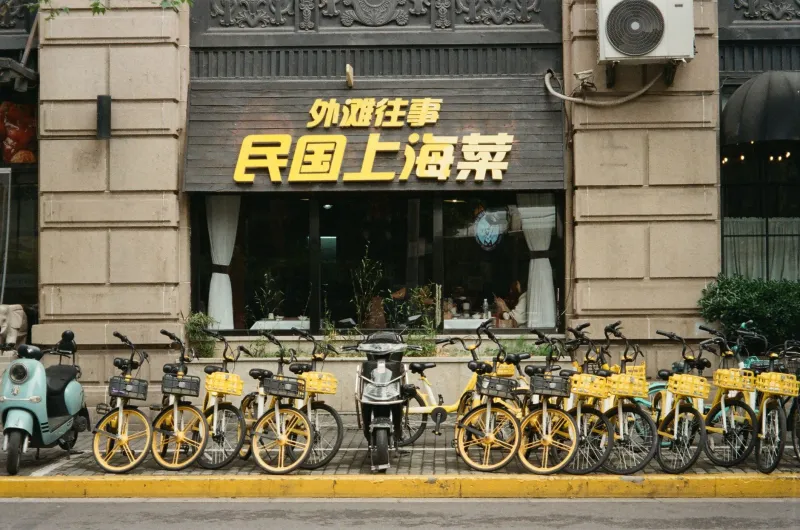
If you're not ready to commit, the green and white shared e-bikes scattered around Hefei (look for apps like Hellobike or Meituan Bike) are a great trial run. Scan the QR code, ride, park in a designated zone, pay a couple of yuan. Caveats: they're capped at lower speeds, they're banned in some central zones, and during rush hour the good ones near metro stations vanish fast.
Treat them as a gateway drug. Most expats who rent shared bikes for three months end up buying.
Winter Changes Everything
Hefei's January damp, plus 30 kilometers per hour of windchill, is a special kind of misery. Locals handle it with handlebar muffs, knee blankets, and full face coverings that make everyone look like a friendly motorcycle ninja. Buy the set. It costs less than one urgent care copay back home.
The Bottom Line
An e-bike will shrink Hefei for you. The wet market six metro stops away becomes ten minutes. The park across town becomes a Sunday habit. Yes, the traffic conventions will take a few weeks to internalize, and yes, your mother will ask you to please wear the helmet.
Wear the helmet. Then go get lost. It's the fastest way to feel like this city is yours.